
The Growth of E-commerce in 2025
The Rise of E-commerce as a Global Power
E-commerce is no longer just a supporting channel for retail. It has become the center of the global economy in 2025. What started in the mid-1990s as an uncertain experiment with Amazon selling books, eBay testing online auctions, and Alibaba connecting suppliers, has now become the very foundation of retail trade worldwide.
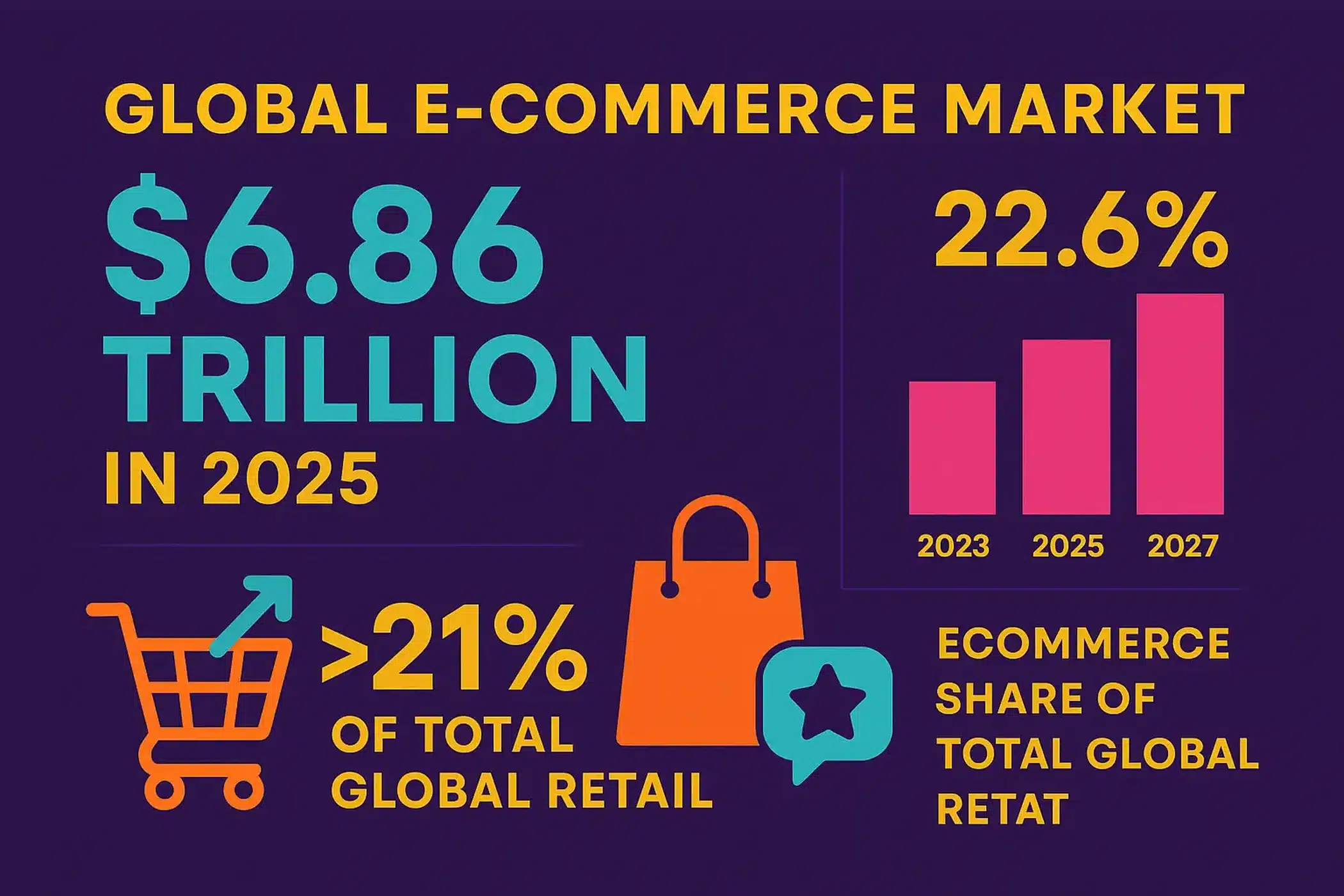
The global e-commerce market is expected to reach 6.86 trillion US dollars in 2025, with some projections placing it closer to 7.5 trillion dollars. This represents more than 21 percent of total global retail, and the figure is set to climb to 22.6 percent by 2027. The change is not only driven by giants like Amazon or Alibaba. Millions of smaller businesses, family-owned stores, and entrepreneurs are contributing to this massive growth by selling through online platforms and social commerce networks.
E-commerce has therefore become a space where size is no longer the main advantage. Innovation, trust, and customer experience are what drive success in this new world of retail. Check out the best e-commerce seo services which helps you generate revenue and stand better than your competitors.
The Legacy of the COVID-19 Pandemic on Shopping Behavior
When the pandemic struck, millions of people were forced to shop online for essentials and non-essentials alike. Supermarkets rushed to launch delivery apps, restaurants opened cloud kitchens, and fashion companies built virtual showrooms. These changes, born out of necessity, ended up reshaping customer habits permanently.
Between 2020 and 2022, e-commerce adoption grew by almost 30 percent worldwide, equal to compressing a decade of growth into just three years. Today in 2025, those habits have not faded. Customers now prefer the comfort of shopping from home, the ability to compare products instantly, and the freedom to buy from anywhere in the world. Physical stores still matter, but their role has shifted. They now act as showrooms, pick-up points, or hybrid spaces for omnichannel retail.
The people who did sold their products with help digital marketing made huge revenue.
Consumer Behavior in 2025
Convenience and Accessibility
Customers in 2025 place convenience above all else. With 91 percent of online purchases made using smartphones, shopping has become an activity that can happen at any moment of the day. If it is commuting, relaxing at home, or during office breaks, people expect smooth checkouts, mobile wallet integrations, and reliable delivery times. Long forms and complicated processes are often the main reasons for abandoned shopping carts.
Personalization and Experience
Modern shoppers do not want to feel like faceless buyers. They expect e-commerce platforms to recognize them, understand their habits, and recommend products that suit their preferences. Artificial intelligence makes this possible by analyzing browsing history, past purchases, and even demographic insights. Personalized product recommendations, targeted discounts, and loyalty rewards create a stronger bond between businesses and customers. Research shows that 40 percent of shoppers purchase based on personalized suggestions, which makes personalization one of the most powerful tools for growth.
Variety and Global Shopping
Geography is no longer a barrier in 2025. Over 52 percent of shoppers now buy internationally, whether it is Korean skincare in Paris, American electronics in Dubai, or handmade crafts from Turkey delivered to London. This openness has given rise to niche brands and specialist sellers who now thrive globally. Customers enjoy having access to products they could never have found in local shops, and this variety has become one of the biggest strengths of e-commerce.
Business Transformation in the Digital Commerce Era
Digital-First Strategies for Retailers
For businesses, e-commerce is no longer an optional investment. It is a requirement for survival. Companies are prioritizing mobile-first design, integrating secure payment systems, and ensuring their websites deliver fast and seamless user experiences. Omnichannel retail, which integrates online and offline touchpoints, has become the standard strategy for most large retailers.
The Role of Supply Chains and Logistics
Behind every smooth order is a complex logistics system. Businesses now rely on warehouse automation, robotics, and AI-driven forecasting to manage inventory and demand. Delivery has also seen dramatic innovation. Drones, smart lockers, and route optimization systems have turned same-day delivery into a normal expectation for many customers. The businesses that succeed in 2025 are those that treat logistics as a core strategy rather than a background process.
Small Businesses and Social Commerce
E-commerce has also empowered small-scale sellers to compete with established brands. Social commerce platforms like TikTok, Instagram, and Facebook Shops have turned individuals into business owners with global reach. A single viral video can transform a local entrepreneur into an international seller overnight. In this way, e-commerce has democratized retail opportunities.
The Economic and Social Impact of E-commerce
Job Creation Across Industries
The rapid growth of e-commerce has created millions of new jobs worldwide. Developers, digital marketers, data analysts, customer service professionals, and logistics workers are all part of this vast ecosystem. In 2025, the industry supports more than 30 million jobs globally, making it one of the largest contributors to modern employment.
Environmental Concerns and Sustainability
E-commerce growth also creates environmental challenges. The increase in packaging waste and delivery emissions has raised sustainability concerns among customers and regulators. 49 percent of shoppers now say they prefer eco-friendly brands, forcing businesses to adopt biodegradable packaging, carbon-neutral shipping, and smarter delivery routes. Companies that ignore sustainability are at risk of losing customer trust.
Challenges Facing E-commerce in 2025
Cybersecurity and Data Protection
The growth of digital commerce also means more exposure to cyber threats. Businesses must protect customers with encryption, fraud detection, and compliance with laws like GDPR. Cybersecurity is no longer just a technical issue; it is central to building trust.
Customer Trust and Loyalty
Shoppers demand accurate product descriptions, high-quality images, reliable reviews, and hassle-free returns. A single poor experience is often enough to make a customer switch to a competitor. Building long-term loyalty requires consistent delivery of promises.
Market Competition and Saturation
With over 28 million e-commerce stores active worldwide, competition is intense. Every day, nearly 2,200 new stores are launched globally, making differentiation harder than ever. Strong branding, unique product value, and personalized customer experience are what separate leaders from the rest.
Fulfillment and Delivery Pressures
24 percent of shoppers abandon their carts due to slow shipping, while 25 percent leave because of forced account creation. Meeting expectations for fast and affordable delivery is one of the most difficult challenges for businesses today.
Future Trends Defining E-commerce Beyond 2025
Mobile Commerce Growth
Mobile shopping is expected to reach 59 percent of global e-commerce sales, equal to more than 4 trillion US dollars. Features like one-click purchasing, mobile wallets, and app-based loyalty programs are shaping this growth.
Social Commerce Expansion
By 2030, social commerce is projected to generate 8.5 trillion dollars globally. Platforms like TikTok, Instagram, and YouTube have blurred the line between entertainment and shopping. Influencers and live shopping streams are becoming mainstream sales channels.
Artificial Intelligence and Analytics
AI is powering everything from personalized recommendations to predictive analytics. Businesses use AI to manage inventory, optimize marketing campaigns, and deliver targeted customer experiences at scale.
Augmented and Virtual Reality
AR and VR are transforming how shoppers experience products online. Virtual try-ons, 3D previews, and immersive environments reduce returns and give customers confidence in their purchases.
Blockchain for Secure Transactions
Blockchain technology is becoming a key tool for secure, transparent transactions. It also improves supply chain traceability, ensuring that products are authentic and ethically sourced.
How Empire DigiSol Empowers Businesses in the E-commerce Era
Empire DigiSol helps businesses succeed in this new age of online retail. We build mobile-first, high-performing e-commerce platforms designed to attract and retain customers. From secure payment gateways to integrated logistics systems, our solutions provide everything a business needs to thrive globally.
We go beyond design. Our services include AI in SEO Services, analytics dashboards, and marketing automation that help businesses understand their customers and grow consistently. For small startups and global enterprises alike, Empire DigiSol creates tools that do not just support online presence but drive measurable growth.
We also prioritize innovation and sustainability. From augmented reality shopping experiences to eco-friendly packaging strategies, we help brands stay ahead of customer expectations. Empire DigiSol ensures that businesses are not just keeping up with e-commerce trends but leading them.
How Online Shopping is Changing the World
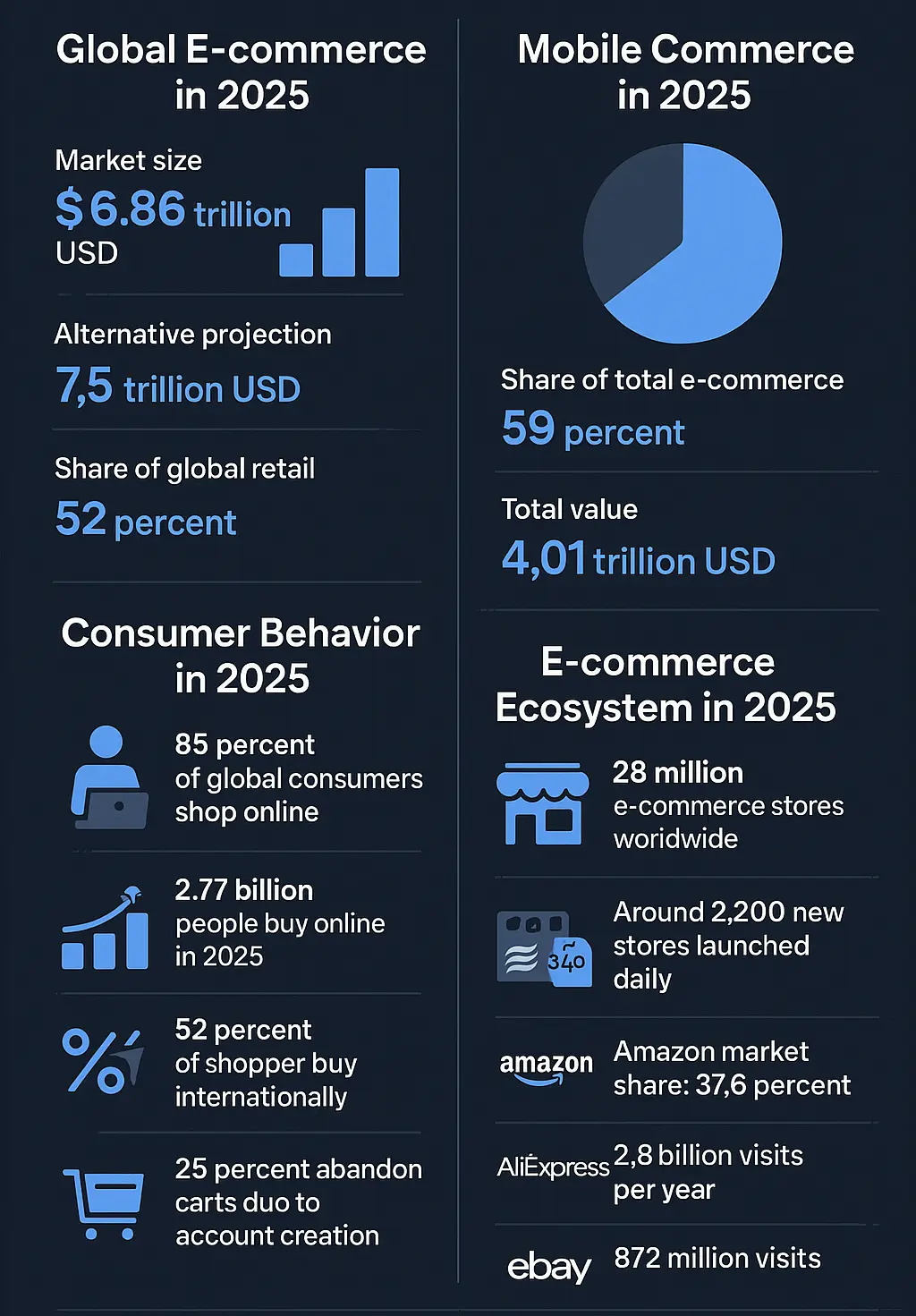
Global E-commerce in 2025
- Market size: 6.86 trillion USD
- Alternative projection: 7.5 trillion USD
- Share of global retail: 21 percent
- Projected share by 2027: 22.6 percent
Mobile Commerce in 2025
- Share of total e-commerce: 59 percent
- Total value: 4.01 trillion USD
- U.S. mobile commerce: 900 billion USD, almost half of national online sales
Consumer Behavior in 2025
- 85 percent of global consumers shop online
- 2.77 billion people buy online in 2025
- 52 percent of shoppers buy internationally
- 25 percent abandon carts due to account creation
- 24 percent abandon carts due to slow shipping
E-commerce Ecosystem in 2025
- 28 million e-commerce stores worldwide
- Around 2,200 new stores launched daily
- Amazon market share: 37.6 percent
- Amazon domains: 2.8 billion visits per year
- AliExpress: 952 million visits
- eBay: 872 million visits
The Empire DigiSol Advantage
- Mobile-first websites
- Secure, multi-currency payments
- Logistics and inventory integration
- AI-driven personalization and analytics
- Augmented reality shopping tools
- Sustainable e-commerce strategies
FAQs
What is the value of the e-commerce market in 2025?
The global e-commerce market is valued between 6.86 and 7.5 trillion USD in 2025, depending on the source. This represents about 21 percent of worldwide retail sales and is projected to reach 22.6 percent by 2027.
How many people shop online in 2025?
Over 2.77 billion people which is about one-third of the global population usually shop online in 2025. This number continues to grow each year as internet access expands.
How important is mobile commerce in 2025?
Mobile commerce makes up 59 percent of global e-commerce, worth over 4 trillion USD. In the United States alone, mobile commerce accounts for nearly 900 billion USD in sales.
What are the top trends in e-commerce for 2025?
The leading trends are mobile-first design, social commerce growth, AI-driven personalization, augmented reality shopping, and blockchain-secured transactions. Each of these technologies is reshaping how consumers and businesses interact.
What are the main challenges for e-commerce in 2025?
The biggest challenges are cybersecurity, logistics, market saturation, and customer loyalty. Cart abandonment remains a critical issue, with 25 percent of users leaving due to forced account creation and 24 percent leaving due to slow shipping.


